Most people's understanding of "affiliate marketing" starts and ends with the Amazon Associates program, one of the biggest in the world.
For the entrepreneur, the challenge with Amazon Associates is building enough traffic to generate substantial revenue. For the newbie, the traffic hurdle is almost unsurmountable. But don't despair! You can create a successful affiliate marketing business, if you do so strategically. What is affiliate marketing? Affiliate marketing is when a publisher or company gives you a cut of each sale they make when you promote them on their site. There are lots of different affiliate opportunities, from courses to web hosting to books, tapes and DVDs. More on affiliate marketing. Let the affiliate marketer beware Affiliate marketing are sometimes touted as "get rich quick schemes" by shady sites offering pyramid schemes that promise quick cash for little effort. Make no mistake -- successful affiliate marketers put in a lot of effort toward building an audience and quality content that will bring in sustainable passive income. Expect to do a lot of legwork up front -- but if you play your cards right you can build a solid source of revenue over time The key to successful affiliate marketing So you've committed to building an affiliate business. Your success as an affiliate marketer is tied to these questions:
Can you find products or services to offer that offer you a great commission rate?
Can you find a niche market that is likely to buy what you are offering?
Are you able to build content and traffic around these products? How to find a favorable commission rate Amazon's commission rate is pennies each dollar of merchandise that you sell. What many people don't know is that there are affiliate opportunities out there that pay commission rates that are much more favorable, from $20-$100. Browse Commission Junction, Share-a-Sale and Ejunkie for opportunities and their general commission rate.
Target a niche If you're just starting out, a niche market is the obvious way to go. Look for a market that has a clearly defined need and willing audience. Then, find affiliate opportunities that dovetail with that niche market.
Create an effective website Once you have a great product you believe and a target market, you'll need to stock a site with quality content that will help drive traffic and affiliate sales. This articlehas some great tips on the nitty gritty of creating your own website. Once you have your website set up, you'll want to optimized it for conversions and sales. Learn about the four qualities of an effective website.
Build an audience through trust The most successful affiliate marketers build compelling content first, and affiliate revenue later.
Chris Brogan has said: "when there’s an opportunity to bring something of value to your community and make some money for your efforts, then you’re looking at what I think of as a great opportunity."
To build a successful affiliate program, it helps to care about the products you are selling, and to offer legitimate value beyond just a quick sale. While you can build an affiliate business around any type of product, it helps if you actually use the product and endorse it personally. Make sure you understand disclosure A couple of years ago, the FCC introduced new rules that covered the increasingly professionalizing world of bloggers. Now you must disclose when you have a financial interest in a product or service you feature on your blog. This goes for sponsored posts, but more importantly, affiliate links.
Many affiliate marketers, including Copyblogger Media and Chris Brogan, attempt to use this to their advantage. How? They use the disclosure as an opportunity to talk about how much they personally love the product they are selling.
We have a great bookstore in my town — the kind of place you picture in your mind when you think of a great independent bookshop.
It’s perfect for browsing, with lots of comfy chairs to relax in. The books are displayed enticingly. There’s a little coffee shop, so you can relax with an espresso. They get your favorite writers to come in for readings, so there’s always an event and a sense of excitement.
They do everything right, and they’ve always had plenty of customers.
But they still closed their doors last year.
No, not for the reasons you might think. It wasn’t Amazon that killed them, or the proliferation of free content on the web, or the crappy economy.
They closed the store because they were leasing their big, comfortable building … and when that lease ran out, their landlord tripled the rent.
Literally overnight, their business model quit working. Revenues simply wouldn’t exceed costs. A decision made by another party, one they had no control over, took a wonderful business and destroyed it.
And that’s precisely what you risk every day you make your business completely dependent on another company.
It might be Facebook. It might be eBay. It might be Google.
It’s called digital sharecropping, and it means you’re building your business on someone else’s land.
And it’s a recipe for heartbreak and failure. What’s digital sharecropping, anyway?
Digital sharecropping is a term coined by Nicholas Carr to describe a peculiar phenomenon of Web 2.0.
One of the fundamental economic characteristics of Web 2.0 is the distribution of production into the hands of the many and the concentration of the economic rewards into the hands of the few.
In other words, anyone can create content on sites like Facebook, but that content effectively belongs to Facebook. The more content we create for free, the more valuable Facebook becomes. We do the work, they reap the profit.
The term sharecropping refers to the farming practices common after the U.S. Civil War, but it’s essentially the same thing as feudalism. A big landholder allows individual farmers to work their land and takes most of the profits generated from the crops.
The landlord has all the control. If he decides to get rid of you, you lose your livelihood. If he decides to raise his fees, you go a little hungrier. You do all the work and the landlord gets most of the profit, leaving you a pittance to eke out a living on.
Well, we’re professional content marketers — not subsistence farmers — and our work doesn’t involve 12-hour days in grueling conditions. So is sharecropping still dangerous?
It is, for a couple of reasons … Landlords are fickle
Let’s look at Facebook. What if you moved all of your marketing to a site like Facebook? It’s local, it’s free to sign up, and it makes businesses feel like they’re doing something cutting-edge.
But what happens when Facebook thinks you’ve done something that violates their terms of service and deletes your account? Or changes the way you’re allowed to talk with your customers?
Facebook is a particularly fast-changing platform, but it’s not the only one. An entire industry has sprung up based on trying to figure out what Google’s going to do tomorrow, both as a search engine and as an advertising platform.
If you’re relying on Facebook or Google to bring in all of your new customers, you’re sharecropping. You’re hoping the landlord will continue to like you and support your business, but the fact is, the landlord has no idea who you are and doesn’t actually care. Landlords go away
The other problem with sharecropping is that the landlord may or may not be here next year.
Sharecroppers have put millions of hours into sites like Digg or MySpace. And those sites still exist — but they’re no longer bringing the traffic they once did.
Sharecropped land, in other words, has a tendency to become less and less fertile over time.
Maybe Facebook, LinkedIn, or Pinterest will buck the trend. Maybe they’ll continue to stay healthy and vibrant for decades.
The best we can do is guess. And if we guess wrong, our business goes into a slow and steady decline. So are Facebook and Google bad for business?
Of course not. Facebook, Google, LinkedIn, Twitter, Pinterest and many more search and social sites are all superb tools to add to our marketing mix.
The secret is to spend most of your time and creative energy building assets that you control.
Developing these assets are the equivalent of buying your building instead of renting it.
Any of these can still fall prey to outside influences. The bookstore’s building can burn down. And your site can be hacked, your email account closed down, your reputation smeared.
But repairing your assets is in your control. You can fix the hacked code, export your email list to another provider, and respond effectively to manage your reputation.
More importantly, you can proactively protect those assets by taking website security seriously, avoiding any spammy or dodgy practices with your email, and cultivating a loyal audience who will vouch for you as being one of the good guys.
You’ve put a lot of time and effort into your business — don’t put it all at risk by building on rented land.
OVER the past five years, marketers have only begun to realize the full marketing potential of the eBook as a both free and paid resource.
And with the autonomy they provide the author over every element from content to design, this format has many benefits that business owners can leverage to grow their authority without having to concede to the wishes of an external publisher.
In this post, we’ll explore the rise of the eBook as a revenue-driving tool, some benefits of the format, and some helpful tools that marketers and business owners can take advantage of to make eBook publishing a little bit easier.
Let’s jump right in.
The Rise of the eBook
Since 2009, Statista research shows that the eBook format has steadily grown – and in North America, it now brings in more than $10M in revenue annually. In fact, over the span of a few short years, this format has already doubled what it makes in yearly sales.
What’s also interesting about this data: It’s clear that North America is still the main market for the eBook, but other markets like Western Europe, and Asia Pacific are catching up, too.
So what’s making this format so popular? Let’s examine a few benefits of the eBook and see what’s behind this increase in revenue.
Benefits of the eBook
The eBook is beloved for many reasons, but here are a few of the key reasons readers are drawn to the electronic format.
Works across multiple devices
As we become more and more reliant on mobile devices like smartphones and tablets, the eBook becomes even more valuable as it works across multiple mobile devices. In a PDF format, readers can access and read content from any device, no matter where they are or what device they’re using. Readers can pick up from where they left off on a tablet and read on a smartphone.
Self-publishing
The playing field is far more open when it comes to the eBook format, as anyone can author, self-publish and promote it through their own networks (think social media, email, blog, etc.) Plus, in this format, you can even release an eBook through channels like Amazon with direct Kindle publishing, too.
On demand
Life is busy, and your readers are constantly on the move. They need a content format that’s versatile and fits their hectic lifestyles–and that can be called up whenever they’re ready for it. eBooks are great for this because they don’t require the modern reader to be tied to the hard-copy format; instead it makes your material portable and accessible on demand.
We know that eBooks are great because they’re easily accessible across devices, they open the playing field for authors, and they’re in a portable, on-demand format.
But maybe at this point you’re asking yourself, “This all makes sense, but how are authors actually creating eBooks?”
Types of eBooks
Today, we see eBooks in many different use cases. Some writers use eBooks as lead magnets and marketing tools to grow their email lists, while others simply look at them as a way to electronically publish their latest story.
eBooks come in many different shapes and sizes, too. Some are short and sweet, while others are long-form novels with more than 70,000 words. The beauty of the eBook is that there’s no rulebook on what the author has to include (or not include) to qualify it as a completed project.
Helpful Tools for eBooks
Writing an eBook is one thing, but the nuts and bolts behind actually assembling and putting it together are another. Some are intimidated by the design and marketing aspects, and it can sometimes hold writers back from ever releasing their creations.
However, tools like Pixel Studio FX allow you to design professional looking eBook covers with simple drag and drop tools (without any technical design training.) This resource includes lots of extras such as:
14,000+ stock images and icons
Hundreds of design templates
3D models of your software boxes, DVDs, book, report, magazine, eBook, etc.
50 MB design storage per account
With a tool like this, you can create a professional eBook cover and other mock-ups for marketing materials without an expensive tool like Photoshop and without having to hire out a freelance designer, all while hoping they share the vision you have in mind.
You can write, design, and launch your eBook without ever having to hire out a single external team member–and the entire experience is autonomous. That’s pretty amazing, right?
Start Writing & Designing Your eBook Today
Maybe you’ve already written an eBook, or maybe you’re considering writing your first. Whatever the case–it’s clear that there’s a growing demand for this format, and more and more readers are coming to enjoy the eBook.
With smart tools that help simplify the creation and promotion process, you can start writing and publishing more eBooks that leave a lasting impression on the world.
What questions do you have about eBook writing and design? Leave them in the comments, and let’s start a conversation where we can help each other out.
Martech's future isn't only about bots and agents talking to consumers. Here's what it means when they start talking to other bots and agents.
Amazon Echo, housing the Alexa intelligent agent
In the past year or so, a new marketing channel has emerged around bots and intelligent agents. This includes voice-based intelligent agents like Google Home’s Assistant or Amazon’s Alexa, and chatbots that interact largely through text conversations. Marketers are beginning to plan their conversational strategies and logic for this channel. But another channel — maybe it should be considered a sub-channel — is about to emerge. It’s when the bot or agent, fulfilling the needs of the human user, is interacting with another bot or agent instead of searching the web, or a knowledge base, or a profile. Just when you thought digital marketing strategy had reached its stasis, we may be in for another major reinvention. In a few years, ArcTouch Chief Experience Officer and founder Adam Fingerman predicted, “most interaction will be conversational.” His company develops apps — and now bots — and he’s conducting a session on “Bot-to-Bot Marketing” at our MarTech Conference in May. In a common scenario today, you might ask Google Home to find a hotel room under $450 in Chicago near the Loop. Google Home searches the web, possibly including reviews on TripAdvisor. To support this user-to-agent/bot interaction, Fingerman told me, “marketers will have to spend more time on reputation management” to ensure that what Google finds is generally good. Hopefully, that will translate into being one of the top results, since a voice-based agent is likely to return only a few. He also suggested brands may need to provide more structured data — possibly in a specific industry-based taxonomy — that makes attributes more transparent so Google Home can do apples-to-apples comparisons about, say, hotel rooms.
The importance of loyalty
Another tilting factor can be loyalty points, which Fingerman said will become more important since you may direct Google Home to Hilton, where you’re a loyalty program member. Eventually, Hilton will want to become more of an active player in this new kind of user interaction. It might pay for top placement when “find me a hotel in Chicago” comes up in a search by an agent or bot. So far, these are fairly standard marketing tools — reputation management, positioning, loyalty programs, paid placement — in response to what is essentially a voice-controlled intelligent search engine. But this can change when the bot/agent acts on your preferences, either stated by you or learned over time from the decisions you make. That’s because the natural evolution of this preferences-based activity by a generalized bot/agent is a personal bot or agent that acts only on your behalf. Perhaps it can search for anything, or perhaps it specializes in hotel rooms. In that case, you might also have bots/agents for finding a great restaurant, or getting the best concert tickets, or whatever. Analyst David Raab pointed out to me that, when you are represented by a personal agent/bot, “brands will have to speak to your preferences.” But those aren’t necessarily the same kinds of preferences that, say, guide the personalization of web content when you visit a particular publisher’s site. Or that cause Netflix to show you more thrillers, because you watch so many of that movie genre. It’s not yet clear exactly how your personal bots will express your preferences, except in their selection of products to recommend to you. Perhaps a preferences profile will be available from the bot.
Bot competition
At the very least, this means marketers’ systems will need to track what your bot(s) chooses, in addition to what you choose. This can lead to new kinds of targeting segmentation, where advertising or marketing systems are segmenting and targeting not just you, but your bots. And it could be more complex than that, because it may not be entirely clear the extent to which your personal bot actually represents the entirety of your preferences. As Raab told me via email:
Consumer-side bots will need to be trained. A bot might just listen to you order pizza a few times to get some idea of how you do it, and then take over, perhaps asking for coaching during future interactions if it’s not sure what you want. People will vary in how much control they’re willing to delegate, and those preferences might change from one day to the next.
You might have personal bots with different authorities to represent your different interests, just as you might have a separate real estate lawyer, a divorce lawyer and a tax lawyer. Or you might have a bot with a deeper understanding of what you like in shoes, compared to another one that only finds slippers for you. For one thing, Raab noted, this could lead to a “competition among consumer-side bots,” where independent providers — incentivized by a percentage of sales — offer personal bots with differing intelligence levels or industry specialties. Beyond the generalized intelligent agents/bots, and the personal agents/bots, it’s quite possible brands may develop their own. (Agents/bots might overlap with platform-specific applications like Amazon’s skills, which some brands have developed, but agents/bots can offer platform-independence and act as a general brand interface.) Hilton’s bot might know how to match the attributes sought, how to offer the right kind of incentives, or even how to negotiate. Brand bots “will need rules for how to interact with [either] people or bots,” Fingerman noted. Rules that don’t yet exist, and which may eventually have to conform with some middleware provided by Google, Amazon, Apple or others.
‘Digital Cohesion’
Inherent in all of this, both Raab and Fingerman point out, is a new incarnation of trust. It might simply be another form of brand trust — i.e., I trust Amazon and therefore I trust Alexa. Or it might be earned trust, where you learn to trust a personal bot provided by a third party because it returns good choices, the way you might learn to trust Pandora’s taste in how it programs a thematic radio station. Raab pointed out that all of this belongs to a broader vision of autonomous technology acting on our behalf, described as “Digital Cohesion” by network solution provider Juniper Networks. In a white paper on the topic, the company broadly defines the term as:… a future in which applications connect and self-assemble to deliver compelling mega-services that enhance our lives.” In one implementation, for instance, a system-wide intelligence monitors a diabetic man’s medical sensors and knows when to intervene and what services to call. Implied in this vision, of course, is that bots and agents are talking to bots and agents. So, it’s not just about finding the best nearby pizza. It could be almost every kind of consumer, health or business choice will be mediated by intelligent bots/agents, probably layers of them. Marketers are just beginning to get a sense of that emerging ecosystem. And you thought the digital universe was settling down.
In this video, I will show you 6 internet business ideas that tend to pay the most in 2017. It seems like everyone is interested in making some kind of extra, if not full-time income online these days. The problem is, there are so many choices that many potential entrepreneurs have no idea where to start. I've covered many different types of businesses that are internet-based, but if you are looking to just get straight to something can support you and your family with high-income potential, this should help. I'll show 6 of your top options and where to get started.
How to make money on Facebook Pages in 2017 and 10 of the best ways to do it. In this video, I'll show you 10 ways to make money on Facebook Pages. Facebook has over a billion users now and if you know what kind of business opportunities to look for, you can really make a huge income from this social media giant. Facebook also happens to be the 3rd largest website in the entire world in terms of traffic. Once you have enough traffic to any page online, it almost doesn't matter how you're monetizing it because you're going to make good money either way. I'll show you the best ways to make money on Facebook, where to go to get started, and even how you might combine a few of them.
In this video I take you through creating your very own Amazon Affiliate/Associate website powered by WordPress and Woocommerce. It's a great way to get started in Amazon affiliate marketing. I'll take you through the whole process from start to finish including setting up hosting, installing Wordpress, configuring your theme and plugins and importing products from Amazon.
Setting up hosting 4:42 Repointing a domain you’ve registered before: 8:00 Logging into your hosting control panel: 9:32 Installing WordPress 10:10 Changing your WordPress password: 11:39 Installing the Flatsome Theme 12:27 Installing the Woozone Amazon Affiliate plugin: 15:41 Configuring the Woozone Amazon Affiliate plugin: 17:33 Importing your products from Amazon: 26:17 Increasing your server PHP memory limit: 30:35 Resizing the product images: 36:45 Adding your logo: 41:01 Customising the colours on your site: 42:23 Importing the demo content: 45:24 Setting up the homepage: 48:07 Tidying up the demo products: 49:33 Getting some images for your homepage: 51:15 Setting up your homepage banners: 51:51 Adding the featured product area to the homepage: 59:05 Removing the best seller element on the homepage and adding recent products: 1:00:59 Adding the 3 text boxes with icons to the homepage: 1:02:52 Setting the product category images: 1:10:22 Tidying the navigation menu: 01:12:22 Tidying up and Editing the static pages like the about us page: 1:16:10 Setting up the top bar & adding social media icons 1:20:42 Creating and adding the top navigation menu: 1:23:42 Setting the my account menu: 1:24:42 Adding Widgets to the footer: 1:25:16 Adding a navigation menu to the footer: 1:27:08 Editing the contact page and adding the form: 1:30:35 Setting up Google Analytics: 1:33:35 Install Yoast SEO: 1:36:13 Setting page titles for SEO: 1:37:00 Submitting a sitemap to Google: 1:39:08 Turning off the coming soon page: 1:41:46 Adding the shop sidebars: 1:43:00
In this video I take you through setting up an affiliate marketing website using WordPress. This tutorial is designed for Beginners so even if you've got no experience in affiliate marketing or making WordPress websites, don't worry, you'll be fine.
Affiliate marketing is when you sign up with an online merchant, or shop as an affiliate and send traffic from your website or social media using special tracking links. When someone makes a purchase from them after clicking one of your links (or in some cases using your voucher code) you get a commission.
A great way to get into Affiliate marketing is setup a review site. With a review site you post honest reviews about products and services along with your affiliate links so people can easily make a purchase. The great thing about a review site is that catches shoppers just before they are about to buy, which in turn can give you a high conversion rate.. :)
In this video we go through everything from setting up the website hosting, through to setting up WordPress and posting some reviews. You can post reviews on anything you like, the WordPress themes are just an example. You can also change all the colours & logo etc allowing you to create an affiliate marketing site that matches your products.
BOOKMARKS
Introduction to Affiliate Marketing and this video: 1:18 Setting up our website Hosting: 9:07 Repointing a domain you’ve already registered: 15:33 Installing WordPress: 18:17 Logging into to WordPress: 19:44 Downloading and installing our Affiliate Website Theme: 21:05 Installing the demo content to get us started on our Affiliate Marketing Website: 25:05 Customising our Affiliate website logo and top area: 27:14 Adjusting colours and fonts: 30:45 Working with review categories: 32:15 Adjusting the text on the homepage: 35:57 Editing and Adding the Affiliate reviews: 37:08 Adding your Affiliate links to reviews: 55:03 Adding the duplicate post plugin to easily copy your content: 01:03:06 Adding banners to the homepage 01:05:37 Working with blog post: 01:13:11 Configuring the widgets in the footer and sidebars: 01:21:23 Final Tweaks and settings including changing the the text in the header: 01:25:32 Customising the menu across the top of the website: 01:28:24 Adjusting the menu font size: 01:30:24 Working with WordPress pages: 01:30:55 Making the Affiliate Marketing Website live: 1:33:00
In this video, you will learn how to make money with Amazon using 11 different tactics. Amazon is one of the biggest websites and marketplaces in the world and they happen to give people many different ways to earn a piece of the profits. I'll mention all the different programs they provide as well as resources you can use and where to get started. Enjoy the video!
There's no doubt that blogging/running a website is one of the most popular activities you can do online. You get to voice your ideas, thoughts, and opinions and share them with the rest of the world, while also improving your writing skills, and connecting with other, similar-minded individuals. You get to write about what you love, and it doesn't get any better than that.
Well, actually, it does get better if you can earn some money in the process. However, while blogging is a lot fun, if you're going to turn into a source of additional income, you're going to have your work cut out for you.
The bad news is, only a small percentage of bloggers and website owners earn huge amounts of money, and most of them are devoted to it and consider it a full-time job. Also, there are those who generate enough revenue for themselves while working part-time in addition to their day jobs. In both cases, it's not something which can happen overnight. It takes time, hard work, lots of trial and error, and patience. The good news is that it is very much possible - this infographic from Website Setup outlines some of the most effective ways you can earn money from your website or blog.
Making money from your website isn’t a myth. It’s doable by everyone. In fact, turning a part-time, hobby blog into an income generating asset is fairly common with a bit of luck and some hard work. At the very least, you should be able to make enough to cover your basic expenses for a domain and hosting. You might even be able to replace your income (and then some). Keep in mind that the strategies listed below range from easy and passive, to ones that require a TON of on-going work (so make sure you pick something that suits your site and lifestyle preferences). There are 33 total tips in this guide, but let’s start with the ten most popular (and predictable) site monetization tips.
10 Most Common Ways to Make Money with Your Website
Making money from your website isn’t easy. But these ten tips are probably your best bet.
1. Affiliate Marketing (.. and affiliate links)
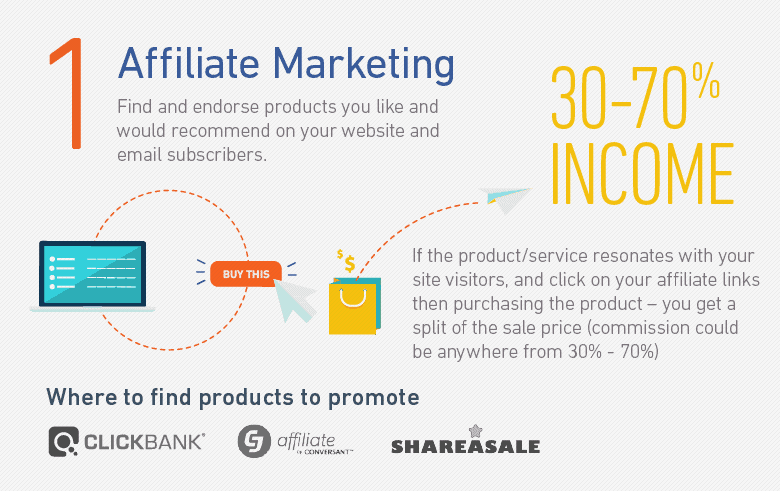
Example of a successful affiliate site: Booking.comAffiliate marketing is one of the most popular (not to mention quickest) ways to make money from your website or blog. Start by finding a product you like and would recommend. Then on your website, you endorse the product and promote it to your website visitors and email subscribers. If the product or service resonates with these people, they’ll click on your affiliate link, purchasing the product (while you get a split of the sale price). The commission might be anywhere from 30% of the product or service price, up to as high as 70%. So for example, if the split is 50% and you promote an e-book that costs $100, you’ll get $50 for simply referring the buyer. Pretty sweet deal, huh?! Where can I find products to promote?
ShareASale – mostly clothes, accessories, and other offline goods.
Clickbank – high percentage payouts, but there’s a lack of GOOD products to promote.
2. Pay Per Click Advertising (Google Adsense)
Example of a successful Google Adsense site: Mashable.comAdWords are the advertisements that show up on the top of Google search result pages. AdSense is the reverse, allowing publishers (which includes bloggers and other website owners like yourself) to tap into Google’s immense advertising network so that other advertisers can run ads on their website. The best part about this system is how simple everything is. Once you sign up, Google will place a simple code on your website that will identify the content of your site and start displaying relevant advertisements. For example, if your site is about pets (dogs & cats), Google AdSense will start showing your visitors ads for cat food, dog training and more. You get paid each time someone clicks on the ad. (Yes, it’s really that easy!) Your cut might be anywhere from $0.50 to $5 per click. However, when your site has enough traffic, you can make hundreds (if not thousands of dollars) each month. How to apply for for Google Adsense?
Apply for AdSense – Before applying, make sure you keep up with their latest Terms Of Service, though. Google has very strict rules, so it’s hard to get (and stay) approved.
3. Sell Ad Space
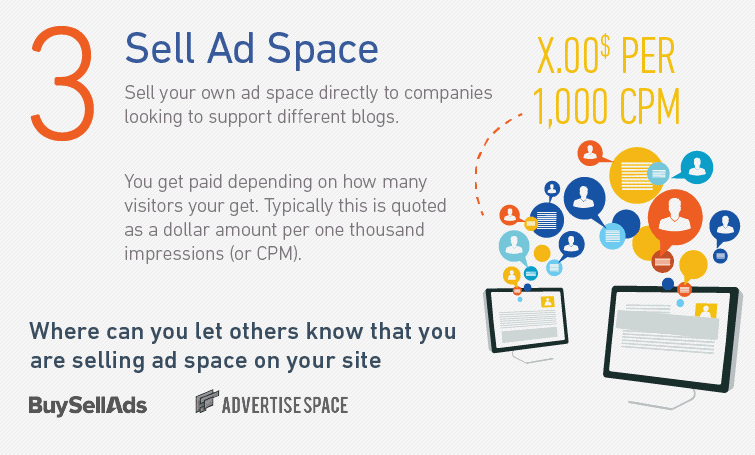
Incorporating Google’s AdSense on your website is just one way to make money from online advertisements. Another is to simply sell your own ad space directly to companies looking to sponsor different blogs. For example, you can come up with a price for each space, like: “Sidebar banner ads will cost $xxx per month”. You can get paid depending on how many visitors you get. Typically this is quoted as a dollar amount per one thousand impressions (or CPM). So for example, you might see it as: $5 CPM. If the website gets 100,000 visits a month, that ad price translates into $500 bucks. The good thing about this approach is that if your site gets a ton of traffic from different sources, your simple banner ad pricing can go up to as high as $5000 per month! However, the obvious downside is that if your site doesn’t get a lot of traffic, you can’t expect to earn as much either. The other common method when selling ad space directly from your website is a simple direct price. Here you simply name a price (based on what you think it’s worth, relative to what the competition might be charging), and get paid upfront at the beginning of each month. This pricing is also generally a simple flat fee, not tied to a Cost Per Click like AdSense. Where can I let others know that my website is selling ad space?
– The most popular one.
AdvertiseSpace – I haven’t tried it, but it should be a good alternative.
4. Sell Your Own Digital Product (Ebook for Example)
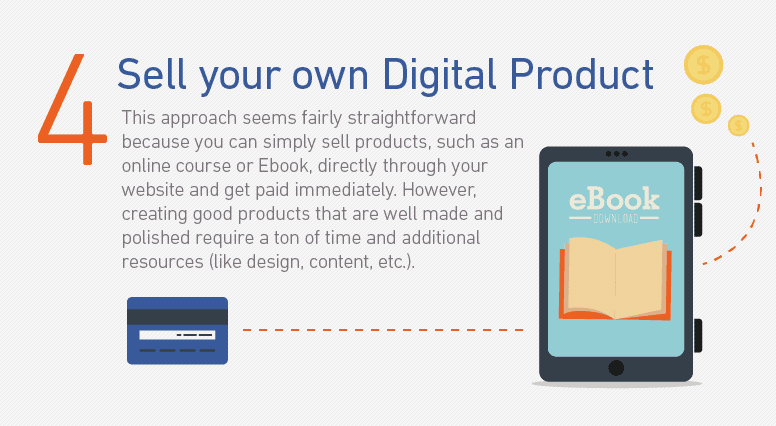
You have the potential to make the most money on a per sale basis when you can sell your own directly. That’s because there’s no middle-man or person in between you and the buyer that’s taking a ‘cut’ from the money earned. This approach seems fairly straightforward because you can simply sell these products directly through your website and get paid immediately. Unfortunately, it’s not that simple in reality. Creating good products that are well made and polished require a ton of time and additional resources (like design, content, etc.). So there’s a lot of ‘hidden costs’ in both time spent or contractors to collaborate with. Selling your own products on your site also bring up problematic issues like payment gateways (how are you going to collect payment?), shipping (how are you going to mail or distribute the products?) and taxes (oh man, don’t get me started). And if that doesn’t sound like enough work already, you’ll also need a well designed, persuasive landing page to make sure your product has a strong conversion rate. Additional resources: How to sell products on your website. How to set up a PayPal “Buy Now” button on WordPress
5. Accept Donations from visitors
Don’t have a ton of monthly visits, but you do have a strong, engaged community? Simply ask your readers to donate! Accepting one-off donations isn’t a fast road to wealth, however, it can help you cover expenses in the short-term if people like what you have to say and want to support your journey. For example, PayPal offers little donation buttons that only take about ten minutes to add to your website, offering you a quick way to recoup what you might be spending on hosting, new product creation, research, and all of the other costs to maintain a healthy, active blog. For example, web.archive.org makes a lot of money from donations (most likely due to their millions of visitors per month). How to set up donation buttons?
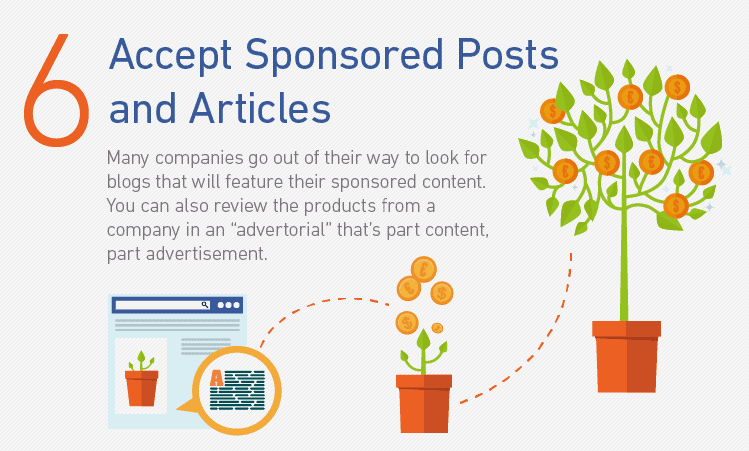
6. Accept sponsored posts & articles (…but use nofollow tag)
One of the common ways to making more money from your website means getting those visitor numbers UP. Once you’ve done the hard work of building steady traffic to your site with an engaged community, there are a few different ways to monetize your hard work. For example, many companies go out of their way to look for blogs that will feature their sponsored content. ‘Native advertising‘ like this works well because it still lines up with your site’s primary content, so it comes across relevant and transparent. You can also review the products from a company in an ‘advertorial’ that’s part content, part advertisement. For example, if your website is all about the latest iOS games for iPhones and iPads, the creator of one of those ads would LOVE to have you review and feature their app to your fans. When done right, this can create a win/win scenario. However done poorly, with irrelevant or inauthentic site content, and it can erode all of the reader’s goodwill you’ve worked so hard to create in the first place. For further reading:
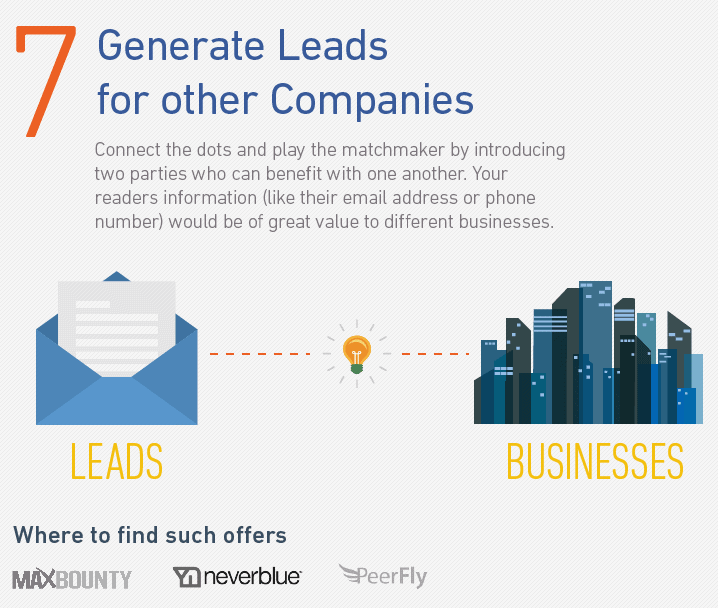
Businesses thrive off new leads coming in their door to inquire about their products or services. It’s no surprise then that they’re always on the lookout, searching for creative ways to find new sources of leads to help them grow. For example: Let’s say you have a website about teaching math skills. Your reader’s information (like their email address or phone number) would be of great value to different online schools who’re looking to sell their courses to eager, proactive students. Basically, you’re connecting the dots; playing the matchmaker by introducing two parties who can benefit one another. While it’s similar to how affiliate marketing works, in this case it doesn’t actually matter if your reader ends up purchasing their product or not. They’re just looking for an introduction at this point. Where can I find such offers?
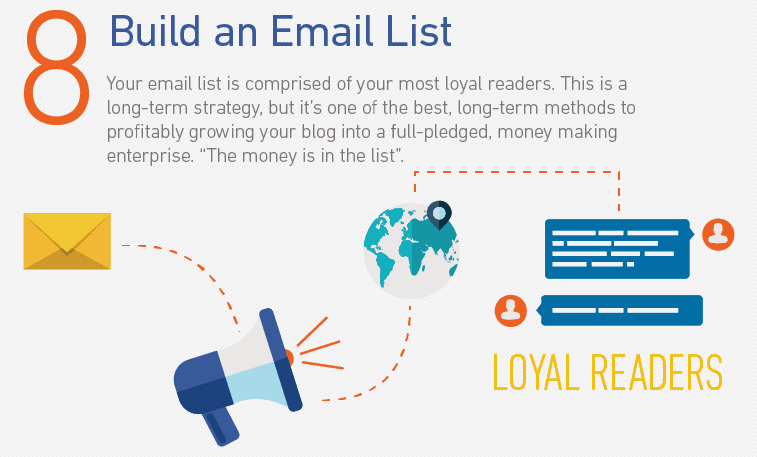
Spend any amount of time reading blog growth tips, and you’re sure to come across people saying “the money’s in the list“. They’re referring to your email list, which comprises your most loyal readers. The objective is to convert as many strangers who visit your site for the first time into passionate followers who want to stay up-to-date on your latest work or content. Admittedly this is a long term strategy (and you definitely won’t get rich overnight). But it’s one of the best, long-term methods to profitably growing your blog into a full-fledged, money making enterprise. Never lose sight of the importance in creating relationships with your followers, however. Offering great information or free help is a perfect way to start. Spamming people with unsolicited offers is one of the fastest ways to abuse reader’s trust and sabotage your long-term goals. How exactly does it EXACTLY work?
Listbuilding 101 – Probably the best introduction on the internet.
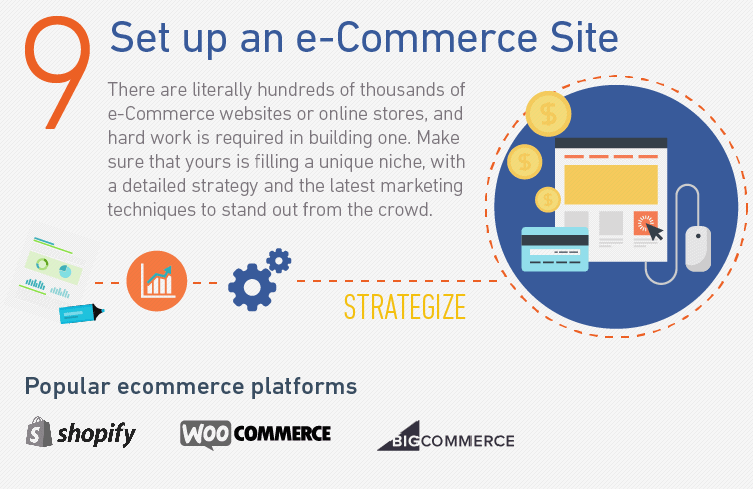
9. Set up an e-commerce site (hard work is required)
Websites don’t have to be just content. They can be centered around tools or products in an online store. Be forewarned, though: There are literally hundreds of thousands of eCommerce websites or online stores. Make sure that yours is filling a unique niche, with a detailed strategy and the latest marketing techniques to stand out from the crowd. How do I create a successful online store/shop?
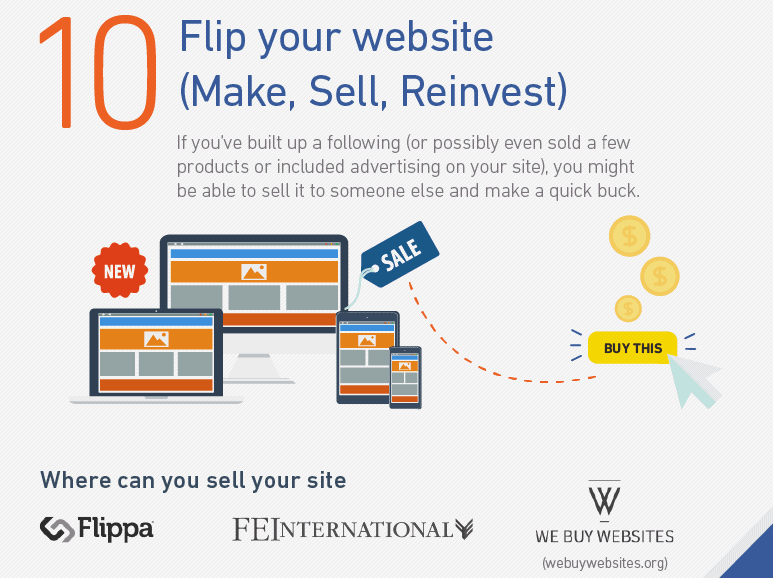
10. Flip Your Websites (Create -> Sell -> Reinvest)
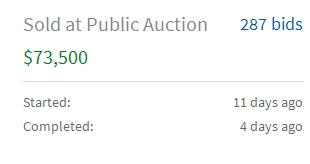
Believe it or not, there’s almost always a market out there for your website. That means if you’ve built up a following (or possibly even sold a few products or included advertising on your site), you might be able to sell it to someone else and make a quick buck. To be honest, I typically don’t suggest people plan on flipping their website or blog. (I’m a bigger fan of creating something for the long term.) But you can’t deny how lucrative it can be. For example, if your website is making $500 per/month through selling ad space, you might be able to sell the site for $5,000 – $10,000 (which is about 12x – 22x monthly income). Another interesting option is to sell ready-made sites, These are MUCH cheaper, but there’s still some money to be made. Where can I sell my site?
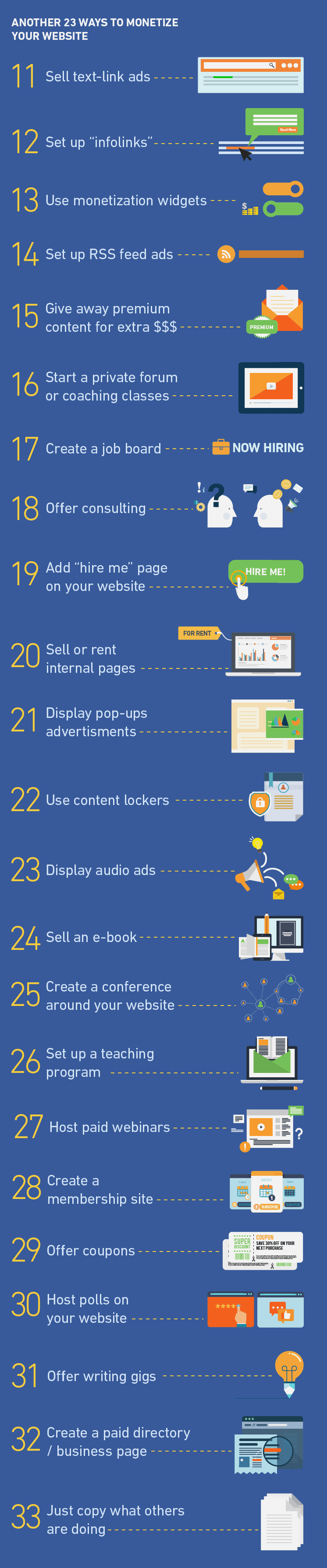
We’ve counted down some of the most popular ways to earn money from your website. However, we’re only just scratching the surface. Below are another 23 ways to make money with your website. (Keep in mind that some of them are slightly connected with the ones above yet they are little ‘out of the box’.)
Another 23 ways to monetize your website
11.Sell text-link ads – There’s still a demand for text-links ads (believe it or not). But please keep in mind that these violate Google’s Terms of Service (which means you run the risk of getting penalized). To avoid it, simply keep the ‘nofollow‘. 12. Set up “infolinks” – Infolinks are a great alternative to AdSense advertisements, that are very easy to setup. However, the downside is that they aren’t high converting, and the payouts (on a per click basis) are also quite small. 13. Use monetization widgets – These are also very similar to Google Adsense, so they’re worth trying out as an alternative. 14.Set up RSS feed ads. – Exactly what they sound like. Ad space for sale in-line with content from an RSS feed. 15.Give away premium content for extra $$$ – If you are producing mind-blowing, awesome content that visitors can’t get enough of… you can always try asking them to pay for some of it! (Crazy concept, huh?!) I’m personally fine with paying for premium content. However, don’t ask people to pay right away. Instead, stay focused on growing an audience and visitors first. 16.Start a private forum or coaching class(es) – Most of us have unique skills that others can benefit from. Setting up a simple forum or classes is an easy way to (a) help others and (b) generate recurring income at the same time. 17. Create a job board– Setting up a job board on your website is another simple, easy way to collect additional money when people accepting different job offers from various companies or individuals. 18.Offer consulting – Offering consulting gigs and providing services can help you bring in decent sums of money while other forms of ‘passive’ revenue take a little time to build up. You can offer these services via email, forum and or even Skype. 19.Add “hire me” page on your website – Your new website or blog is also a perfect place to feature your freelancing services. Showcasing samples or evidence of past work will help greatly increase your chances of getting hired. 20.Sell or rent internal pages – These aren’t very common, however, you might be surprised at what people would be willing to rent or spend money on! 21.Display pop-ups advertisements – Pop-ups can be extremely annoying. However, they’re also another easy way to make some quick money. 22. Use content lockers – ‘Content locking’ is similar to hiding or protecting pieces of content until a visitor takes some action to redeem it. For example, maybe you want them to pay a small amount, or perhaps click on an advertisement. 23. Display audio ads – These are relatively new and are becoming increasingly more common. Personally, I haven’t tried it. But I have read some articles and it definitely looks promising. 24. Sell an e-book – This one is a no-brainer. Many people sell e-books through their site. Some examples: If you have a website about recipes and cooking, you can easily create and sell your own recipe book. The same applies in almost every single other niche. 25.Create a conference around your website – Lots of work, but a huge potential payoff as well. 26.Set up a teaching program – Kinda like a cross between selling your own content and offering consulting or services. 27.Host paid webinars – Similar to the last tip, which is largely a mix of consulting through content. 28.Create a membership site – Yet another tier on the ‘info-business’ model that has the added benefit of bringing in recurring revenue. 29.Offer coupons (with affiliate links) – People are eagerly looking for discount & promo codes for everything from clothes to travel vacations. If you can (find and) offer a valid one, you can also get a cut of the revenue too. 30. Host polls on your website– Hard to believe, but easy to do! 31.Offer writing gigs – You can easily make $20 – $30 per 500-word articles writing for other companies or individuals. There’s also a huge potential for fluent speakers of different languages, as many companies want their websites translated by those who speak the native language. 32.Create a paid directory/business page – You charge people for listing or submissions to the page. 33.Just copy what others are doing – My personal favourite!