Showing posts with label advertising. Show all posts

Wednesday, 19 July 2017

Action Content: Turn Fans into Customers [Plus a Free Bonus for You]


This article is part of our series on the 4 Essential Types of Content Every Marketing Strategy Needs. Make sure to get your special free bonus at the end of the article.

So far, we’ve covered Attraction, Authority, and Affinity content. Now it’s time to turn your fans into customers with Action content.
And this is where all the work you’ve done as a content marketer starts translating into revenue for yourself, your clients, or your organization.
The good news is that Action content is probably the easiest type of content to understand. But the bad news is that it can also be some of the most difficult to produce.
We’ll dig into the reasons why shortly, but since we are in the habit of defining each term before we get started, let’s do that here for Action content:

Action content is content designed to get somebody to take an action.
How about that for easy?


The marriage of copywriting and content marketing

Content marketing is a new kid on the block in some ways, surging in popularity in the last five years.
In other ways, content marketing has been paired with advertising for quite some time. Take John Deere’s 118-year-old magazine, The Furrow, as an example.
The Michelin Guide, first published in 1900, is another great example of classic content marketing.
However, what I’m talking about here is the marriage between copywriting and content marketing.

A marriage between copywriting and content marketing helps you attract attention, increase engagement, and then ultimately, persuade someone to take action.

Types of actions

When you create content, you should have an action in mind that you’d like the reader to take. Actions could include, but aren’t limited to:

  • Asking your readers to comment on a blog post
  • Asking your readers to share an article or podcast
  • Asking people to participate in a poll or survey
  • Encouraging people to download a free video training course
  • Persuading people to subscribe to your email newsletter
  • Convincing people to follow you on social media
  • Enticing people to hire you
  • Getting people to buy your product
Naturally, you’ll want to start off with small requests. Get people used to taking your advice and following your instructions.
You first want people to say, “Hey, I want to pay attention to this person (or this company, or this brand) because it’s really relevant to my current challenge and the journey I’m on.”
You get people to warm up to you and trust you — step by step — until the sale, and then the repeat sale or the recurring sale.
Let’s look at some successful pieces of Action content.


Examples of Action content

The most obvious piece of Action content you will create is promotional — sales copy that you publish and run for the duration of the offer. After the sale is over, we recommend you remove the post from your site.
Action content also includes landing pages, like this one on content marketing that encourages visitors to register for Copyblogger’s content library.
In addition to those two cases, your best content will combine all four types of “A” content. Here’s a stellar example: What’s the Difference Between Content Marketing and Copywriting?
What makes it so great?

  • It’s useful. The headline suggests you are about to learn something important. The question-style headline also helps attract attention. People wonder whether or not they do indeed know the answer. They think, “This might be too important to miss.”
  • It’s authoritative. Sonia Simone’s years of working in the copywriting and content marketing world turned what could have been a shallow answer into an extended clinic in effective writing.
  • It takes a stand. The content exposes people to one of our core philosophies at Copyblogger: Really good content is unsurpassed at building rapport, delivering a sales message without feeling “salesy,” and getting potential customers to stick around.
  • It’s laced with action. You might not see it at first blush, but this piece of content motivates readers to check out the educational resources Copyblogger has to offer — from the My.Copyblogger free membership site to the paid offers like Authority and Content Marketing Certification.
The success of this content wasn’t accidental. There was a plan: the content primes people for when we actually do make an offer.


How to write Action content

Writing something interesting to fill space and keep people reading won’t cut it here.

That’s not as complicated as it might seem, because all you have to do is ask yourself this simple question before you write each piece of content:

What is the action I want my audience to take?
Now, getting people to actually take that action requires some skill. Like I said above, this is the hardest type of content to master. It takes time to learn copywriting skills, and it also takes time to master them.
The following resources can help you:

Once you’ve worked through that list, the next best thing you can do is to practice. Write. Then write some more.
And on that note, let me close with a little encouragement.


Keep your chin up

When I first got into copywriting, I threw myself into it whole hog.
I devoured every book I could get my hands on. Tore through successful promotional pieces. Listened to a legion of cassette tapes on the art of direct response copywriting, human psychology, and negotiations — yeah, this was way before podcasts. Wrote a mountain of sales letters, emails, and text ads (and then watched mentors tear them apart).
This went on for years. I thought I knew my stuff. However, it wasn’t until about Year Five when things clicked … when I turned the corner and all that head knowledge became heart knowledge.
The moral of this short story is that if I can learn how to write Action content, so can you. But it’s going to take time. Don’t expect too much of yourself too soon. Just start learning, publishing content, measuring results, adjusting, asking for feedback, and so on.
You can do it.


Get your free ebook: 4 Essential Types of Content Every Marketing Strategy Needs

Build a content strategy based on the four content types in this series! Get your free ebook, 4 Essential Types of Content Every Marketing Strategy Needs.

4-essential-content-types-cover-500


Click to get the free ebook

Over to you …

What’s your favorite example of Action content?
Drop us a note in the comments section below to share your thoughts.


Source

Tuesday, 18 July 2017

5 Dang Good Reasons Why Writers Should Think of Themselves as Content Marketers


Perhaps you are a journalist by trade, dreaming of working in a big, bustling city like Seattle or a cozy college town such as Athens, Georgia.
Maybe you are a die-hard copywriter, having cut your teeth on direct response campaigns through snail mail, but you’re looking for a faster-paced challenge.
Or maybe you are like me: an English Literature graduate from the Midwest who wanted more out of life than days waiting tables and nights working on poems no one would read.
No matter which category you belong to (or maybe you defy all categories), you know you are a writer because you love to write. You love thinking about writing. You love to have people read your writing …
And, more importantly, you’d love to get paid to write.
The bad news is you won’t find “writers” on the list of the fastest growing careers. The good news is, I think that’s going to change pretty soon.
Why? Simple: the rapid and powerful rise of content marketing.
Because of the content marketing boom, we are now living in the age of the online writer.
Who exactly is the online writer? What does she look like?
She is a person who has an:

  • Average understanding of SEO
  • Average understanding of usability
  • Above average understanding of social media
  • Outstanding understanding of copywriting
  • Above average understanding of storytelling
  • Average research skills
  • Average caffeine appreciation
  • Above average combative work ethic
You can carve out a pretty satisfying career as a web writer if you have all of these skills. If you do, congratulations. However, I want to encourage you not to stop there.

The rewards of evolving into a content marketer

I want you to go further and turn yourself into a content marketer. A content marketer is a person who has an:

  • Outstanding understanding of content strategy
  • Above average understanding of SEO
  • Above average understanding of social media
  • Average understanding of subscription assets
  • Average research skills
  • Average understanding of conversion skills
As you can see, there is some overlap between the two lists.
If you already have all the qualities of a web writer, that means you are ahead of the curve. You just need to bone up in a few other disciplines, and you’ll be on your way toward becoming a full-fledged content marketer.
Some of you might have a little farther to travel: you don’t have all of these skill sets yet. But don’t fret. We all start somewhere.
The good news is that if you keep going, striving, learning, and practicing, you’ll build the natural authority that makes you an in-demand content marketer.
But no matter how far you have to travel, a little encouragement never hurts. Besides, for those who have a longer road to travel, encouragement makes the journey more enjoyable.
That’s why I want to share five reasons that will encourage you to think of yourself as a content marketer.

1. The demand for content creators is still growing

What’s driving this demand? According to a late 2015 update to a previously published Forrester report, research suggests consumers demand more content (if it’s good):

“Marketers who create valuable content and stories that attract audiences … build valuable relationships with customers and generate positive business outcomes.”
In this digital age, consumers are in control of the purchase process and want information before they make decisions. Any company that relies solely on traditional advertising tactics will likely struggle.
According to Content Marketing Institute’s research report, B2B Content Marketing – 2016 Benchmarks, Budgets and Trends – North America, 76 percent of B2B companies said they’ll increase content creation (slide 14). And to accommodate this increase, 51 percent of companies said they’ll increase their budgets (slide 26).
As a result, businesses will need more writers with a flair for content marketing.

2. Ad blocking will increase content marketing budgets

Late last year, the number one most downloaded app was for ad blocking.
This fast adoption of ad blocking software has caused publishers to spin out of control. According to an often-quoted Adobe and PageFair study, ad blocking software was estimated to cost publishers $22 billion in revenue during 2015.
That’s a lot of money.
But a bloodbath for independent media is probably overstating the case. More than likely, publishers will shift gears and adopt a content marketing strategy over a traditional advertising one, with a particular focus on content distribution.
As a result, businesses will need more writers with a flair for content marketing.

3. More companies will invest in content distribution

As Contently stated in their 2016 State of Content Marketing report, 70 percent of content marketers spend less than $1,000 on content distribution.
That percentage is expected to change once companies realize that the most successful content marketers spend a higher portion of their budgets on content distribution (like sponsored content) than their less-successful peers.
As a result, businesses will need more writers with a flair for content marketing.

4. More SEO budgets will shift towards optimizing content for discovery and conversion

In the last five years, Google has aggressively focused on rewarding high-quality content. A by-product of this intense focus is that we no longer think of SEO as a standalone practice.
Instead, consider Sean Jackson’s phrase “OC/DC” (Optimizing Content for Discovery and Conversion). OC/DC encapsulates the idea of amplifying the overall reach and results of content creation.
Yes, great content may well result in traffic from Google, which is important. But a more holistic strategy pulls in traffic from a variety of sources — social media, related blogs, content distribution (see section 3), and so forth.
Optimizing content for discovery and conversion requires a writer to think like a content marketer — the person who, as I listed above, has experience with social media, subscription assets, republishing, and conversion copywriting.
As a result, businesses will need more writers with a flair for content marketing.

5. More social sites are becoming publishing platforms

First it was Medium, a social site that gives people an unlimited space to write (even if it’s not original content). Then LinkedIn opened its publishing platform to everyone.
Since then, Facebook released Instant Articles, which allows publishers to share content directly inside the Facebook app — last year to a limited group of brands. They’re slated to open it up to everyone soon, even your grandma.
And longer tweets may be coming soon to Twitter.
While social platforms may encourage content syndication, there is also an opportunity to tailor content for an audience on a specific platform. BuzzFeed is one such pioneer.
As a result, businesses will need more writers with a flair for content marketing.

Avoid digital sharecropping

I should point out, soon-to-be content marketer, that if you set up your content marketing strategy properly, it doesn’t violate our long-time advice not to overbuild on someone else’s land.
Rather than building mini-empires on other platforms, focus on creating definitive articles on your own site. Once that’s in place, use social platforms to drive traffic back to you.

You’ll optimize your related social media content for each specific platform where you publish, but all roads lead back to you and your original authoritative content.

Who’s hiring content marketers?

These five reasons suggest that the demand for content will continue to increase. But who’s actually hiring content marketers? Here are a few places:


Tuesday, 23 May 2017

The Foundational Guide to Your Online Marketing and Sales Funnel


Online sales and marketing is complex. I mean seriously complex.
I’m going to try my hardest to dumb it down. Not because you’re dumb, but because it’s complicated.
This guide will be broken up into 5 stages, taking you step-by-step through a comprehensive breakdown of the online marketing and sales funnel from top to bottom:
To skip straight to the section you're interested in most, just click on the link in the table of contents above.
If you have any questions let me know in the comment section.
Let’s get into it!
If you want to download this article as a PDF to keep it as a resource, just click here!

Marketing and Sales Funnel Stage One: Driving Traffic


The first step of your online sales funnel is making all about driving traffic to your website.
There are two primary ways to do this, SEO and advertising: organic traffic and paid.

1. Use SEO to drive people to your blog and website

SEO, or search engine optimization, is a broad term for an endless number of strategies all focused on getting your business to the top of a search results page (SERP) when someone types in something related to your business.
SEO is the foundation of content marketing: creating content (usually a blog) which answers the questions your target market has.
For instance, it’s entirely possible you found this article by typing something like “simple guide to marketing funnels” into Google. This article appears because it contains the keywords you typed in, as well as dozens of other reasons (like link-building, page authority and more).

2. Use advertising to drive traffic to your website

The alternative to SEO (though of course they can be done at the same time) is paid ads: paying for people to see your business.
First option is to pay for Google Ads...
Depending how much you pay, this will guarantee your business is on the first page of Google search results for your target keywords.
marketing and sales funnel guide
Google ads also include “display ads,” which are predominantly those top and side-bar banner ads you see everywhere online.
Important Points about Google Ads:
They’re often referred to as PPC Ads, which stands for “Pay-per-Click”. This is because the dominant budget structure is based on your business paying every time someone clicks on your ad.
The amount you pay changes based on how competitive your keywords are (as in, how many people want to have their ads shown when someone types them in) as well as how prominently you want your ad to be featured.
Pricing varies, somewhere between $1 a click and $75.
Second option is to pay for Facebook Ads…

Facebook Ads feature on the Facebook newsfeed, either right in the middle amidst user’s statuses and updates, on the sidebar below the trending stories, or on mobile newsfeed (which doesn't have a sidebar).
One of the coolest features of Facebook Ads is its targeting. Where Google allows you to drive traffic from people searching for something related to your business, Facebook allows you to show your brand exclusively to people likely to be interested in it.
Important Points about Facebook Ads:
They’re cheaper, but have about around 1/10th the click-through-rate of Google Ads.
My first recommendation for getting the most out of Facebook advertising is to inform yourself as much as possible.
Look up “custom audience targeting,” “website custom audience targeting,” and “lookalike audience targeting.” Build an audience at least 100,000 people strong, but no more than 300,000. Create many different ads (try Facebook's Power Editor Chrome plugin for that) and test them against each other until you find the design that works for your target market.
For more on Facebook ads, check out my article “How B2B Content Marketers can Use Facebook Ads to Generate Leads." Alternatively, check out "5 Facebook Ad & Landing Page Combinations Critiqued.
No matter what strategy you choose to drive traffic to your website, you need to ensure that, when they get there, they engage with you in some way (to keep them on the path to becoming customers).
Which leads us to generating leads…

Marketing and Sales Funnel Stage Two: Generating Leads


Lead generation is the stage of your funnel in which an anonymous website visitor becomes a real person - someone you can communicate with and show how awesome your business is.
And it’s a critical component. After all, it doesn’t matter if you’re getting one website visitor a month or one million, if none of them are becoming customers you’re in the same position either way.
Lead generation puts you on the right track to positively influencing the chance of a website visitor becoming a customer. Without it you’re just crossing your fingers and hoping.
There are a few major pieces of the lead-gen funnel you need to know about: 
1. Free-trial lead generation 
2. Opt-in lead generation 
3. Landing pages

1. Free Trial Lead Generation:

Free-trial leads are considered “warmer” leads than opt-in leads or subscribers. They’re likely shopping around between your business and competitors.
The act of moving a free trial lead to a paid plan is called “onboarding” and is done a couple primary ways: account managers/sales associates and email nurturing.
Account Managers: Facilitate (generally B2B) onboarding through personal email, platform demos and sales calls. This strategy for onboarding is time-heavy and works best for high-priced services. That said, it can be made easier with an automation and CRM platform which allows for in-depth lead details and keeps a schedule of communication.
Email Nurturing: For companies whose free-trial numbers are a bit beyond the capability of even the largest account manager department, the best option is a complete email-marketing strategy. Ideally triggered by the action of your leads, your business sends emails based on your free trial lead’s interests.
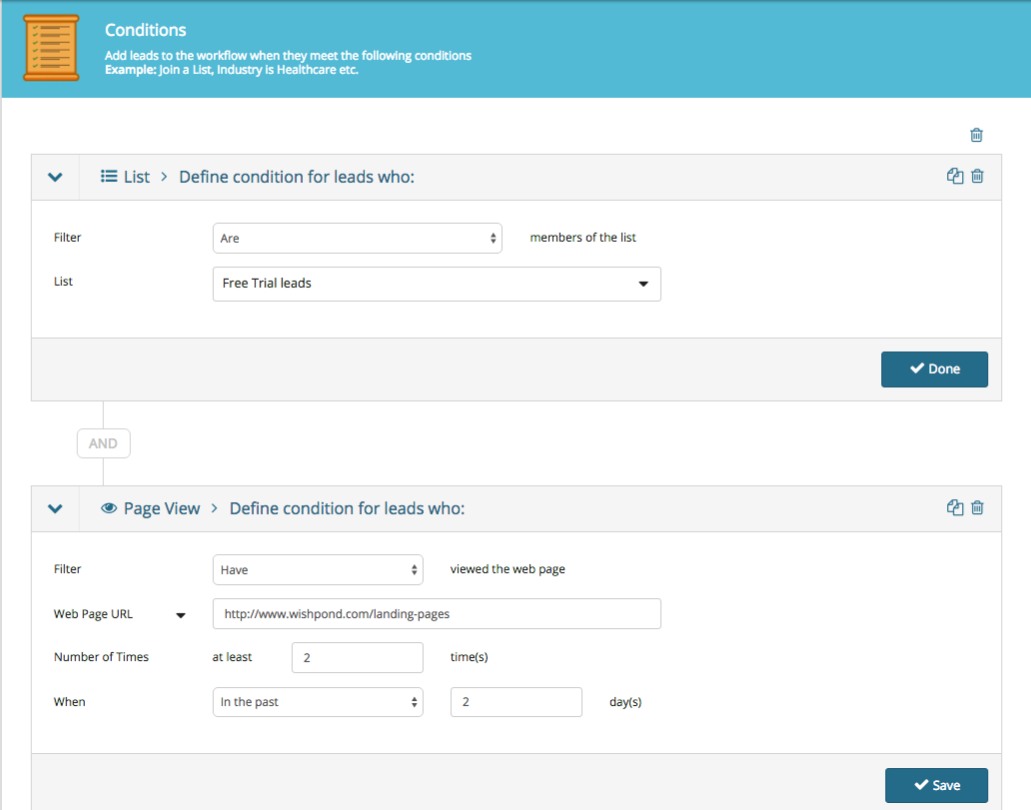
For instance, let’s say your free trial lead visits one of your business’ product pages twice in two days. You might want to send them an email asking them if they have any questions about the product or offering a platform comparison sheet focused on that specific product.
Here’s the simple set of conditions you’d set to trigger that email being sent in a marketing automation platform:
marketing and sales funnel
I’ll get into the actions this might trigger below.
Important Points about Free trial Leads:
To onboard a free trial lead it’s essential you give them each and every selling-point your business offers. But it’s equally essential you do this in a less-than-salesy way. I recommend delivering buying guides, case studies, competitor comparison charts, and making your exchange as personal as possible.
For more on onboarding free trial leads, see the section on late-stage lead nurturing below.

2. Opt-in Lead Generation:

Your business can generate opt-in leads by offering valuable content to people in exchange for their email address.
Essentially, your business creates valuable, educational content interesting to your target market. Either through blog subscription (i.e. a reader of your business’ content decides they want to receive it regularly and subscribes via a form or website popup) or email-gated content (i.e., a visitor to your site or blog is incentivized to provide their email address in return for an email-gated comprehensive resource).
Important Points about Opt-in Leads:
Opt-in leads aren’t equivalent to free-trial leads (which are already semi-nurtured) and as such they’ll need more nurturing before they become clients or customers.
Even so, the benchmark percentage of opt-in leads who end up actually closing is lower than 10%.
Which is why we need to generate as many of them as possible, and also ensure they’re as qualified as they can be. That, of course, brings us to landing pages….

3. Landing Pages:

Landing pages are how you get the opt-in of most of your leads. For the purposes of this guide, I’ll be more accurately describing squeeze pages in this section (which are simply landing pages optimized for lead generation).
For instance… 
marketing and sales funnel guide
Creating a landing page like this one places a visitor’s attention on the single conversion ask: there’s no navigation bar, no sidebar links, and the focus of the page is on the CTA button.
Software company Axway increased their marketing ROI by 291% and saved $100,000 per year by building custom landing pages for their PPC ads. Instead of sending traffic to their homepage they built a dozen landing pages designed for conversion. It just makes sense. 

Click here to check out Wishpond’s landing page platform and start building your own optimized funnel, completely free up to 200 leads.

Marketing and Sales Funnel Stage Three: Nurturing Leads


Just like there’s no point in driving traffic to your website if you’re not converting them into leads, there’s equally no point in generating leads if you’re not going to turn them into sales.
The best strategy of email marketing is what’s called an email drip campaign, so called because of those fancy irrigation systems which slowly drip water onto a plant or seed.
Essentially, you deliver a set series of emails (6, initially) over the course of a couple weeks from the moment your lead gives you their information. These emails are designed to inform and educate your lead, develop trust and a relationship, and ultimately encourage them to find out more about your business and eventually become a customer.
Let’s get into the specifics...

Email Drip Campaigns:

A critical component of lead generation is segmentation: you need to know what your leads are interested in so you can effectively nurture them towards a sale.
For many businesses this will be straightforward (particularly if you do one thing). For others (Wishpond for example) it’s a bit more complicated.
Businesses might have a few different selling-points. If a lead is particularly interested in one of them, selling them on another might be completely ineffective.
The best strategy for nurturing opt-in leads is to do so based on the subject they converted on initially. For instance, let’s say someone converted on an opt-in page for an ebook on landing pages, here’s how we’d set up an email drip campaign on that subject:
Firstly, write your emails… Although you should test the frequency and content of your lead-nurturing emails, the rule of thumb is 4:1:1: four educational, one transition email, and one sales email:
  1. First article: Basic - simple but highly relevant
  2. Second article: Transparency - builds rapport
  3. Third article: Resource - highly valuable for every business
  4. Fourth article: Personal - “Mistakes I’ve made and what I learned” with some business exposure
  5. FIfth article: Comprehensive - long-form, shows your business clearly
  6. Sales: Personalized and informal. Prompt a conversation, VIP demo, or free trial.
For a lead interested in landing pages, they might look like this:
  • Email #1 Subject Line: “The next step for your landing pages”
  • Email #2 Subject Line: ”We just did something with our landing page that you have to try”
  • Email #3 Subject Line: ”Free image resources we've compiled since 2013”
  • Email #4 Subject Line: “My most influential landing page A/B tests from 2015”
  • Email #5 Subject Line: “How to set up a sales funnel with multiple landing pages (step-by-step guide)”
  • Email #6 Subject Line: “Setting up a time to talk landing pages”
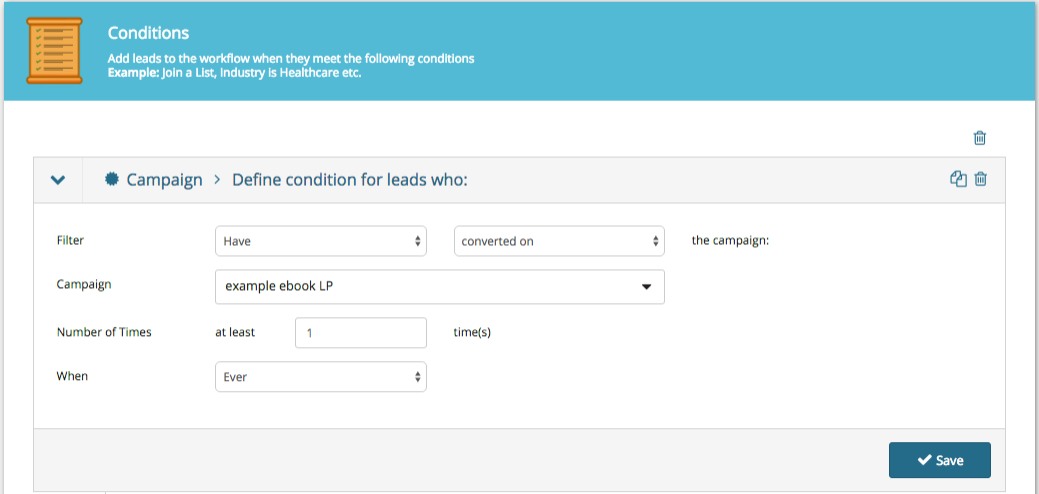
Secondly, set the conditions of your email drip campaign.
guide to marketing and sales funnels
This basically just says that all leads who have converted on an opt-in page (in this case, for a landing page ebook meet our conditions and will be sent our nurturing emails.
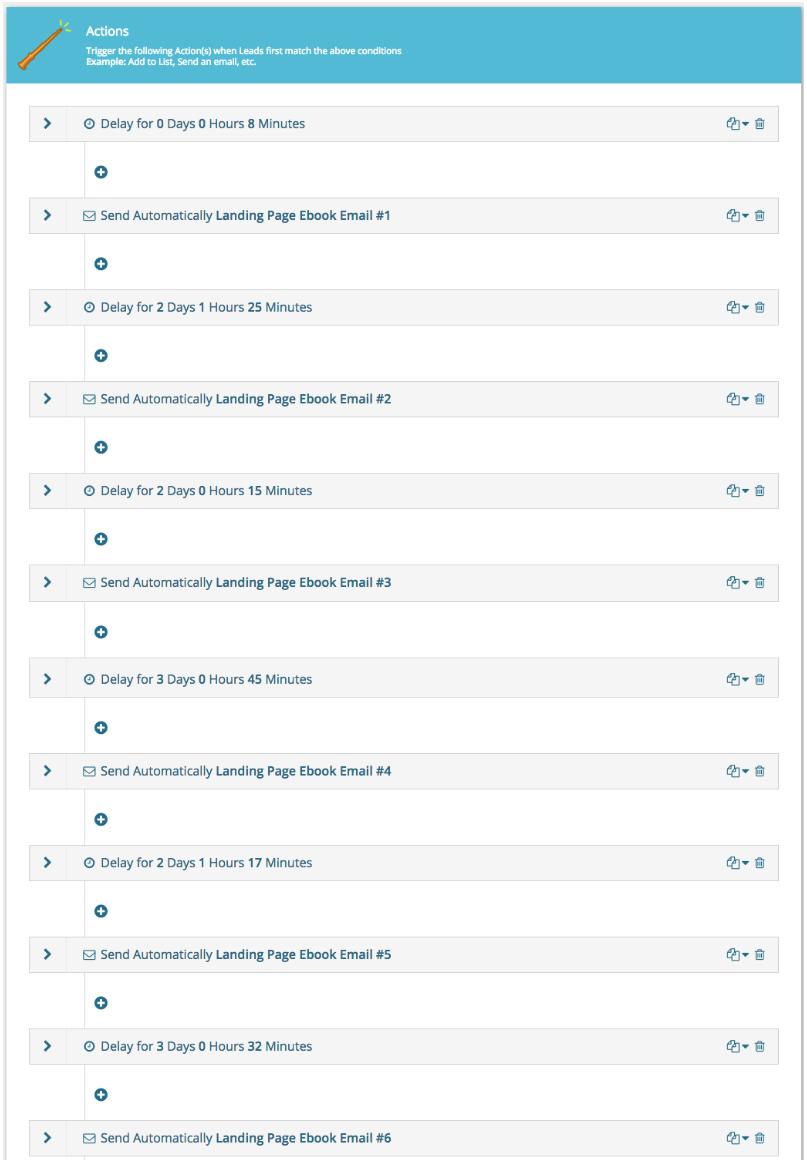
Thirdly, set the actions for this workflow. We need to determine what happens when someone meets the conditions above:
guide to marketing and sales funnels
I’ve set a 7 minute delay after the initial condition is met (conversion) and then two or three days between all the subsequent drip emails being sent. I send them around the same time every day to better personalize the campaign.
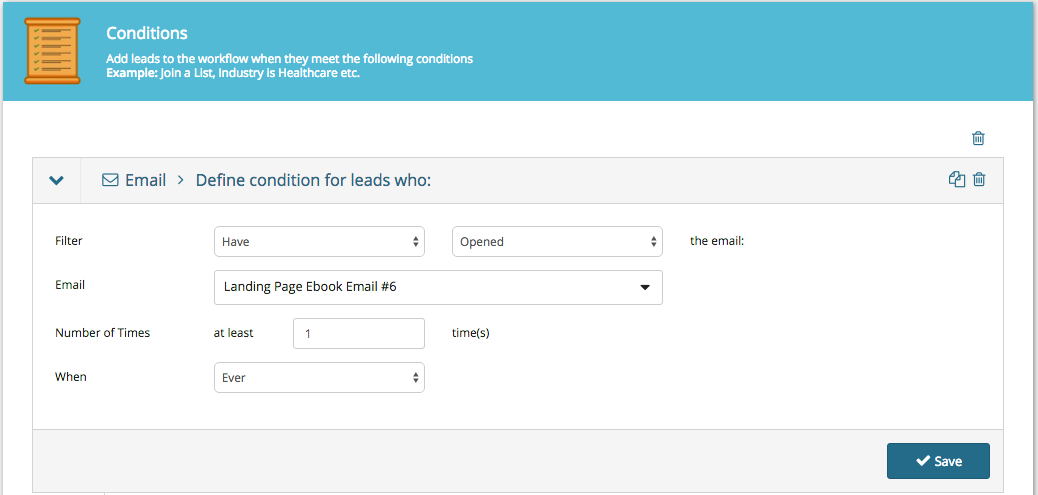
Next we have to set a separate condition to stop our workflow and move our leads to the next stage of our sales funnel...
guide to marketing and sales funnels
Important Points about Email Drip Campaigns:
The most crucial part of email marketing drip campaigns is testing your content. You’d be amazed how impactful a simple subject line change can be on a campaign’s open or click-through rates.
A few lead-nurturing best-practices to keep in mind:
  • Keep it personal. Use first names, casual language, and prompt a back-and-forth. It’s far harder to unsubscribe or refuse a request from someone you’ve spoken to personally or have a relationship with.
  • Keep it focused on the subject they’re interested in. Segment carefully. Test the resource email I’ve recommended above.
  • Keep it short and to the point. Tech and B2B leads receive dozens of emails every day (at least). Make yours easily skimmable and ensure it communicates value quickly.
  • Have someone monitoring the “from” email account. If a lead being nurtured does respond don’t let that communication be lost.
For more on creating email marketing drip campaigns, check out my article "How to Create Email Drip Campaigns to Nurture Leads"

Marketing and Sales Funnel Stage Four: Closing Leads


Now it’s getting exciting. We’re a simple step away from turning a hot lead into a closed lead. They just need that little nudge.
This next stage is a short and simple one, very similar to the one before...

Late-stage Lead Nurturing Campaigns:

A late-stage lead is someone who has expressed interest in your platform beyond the fact that you produce valuable content.
This is a delicate stage, as it’s essential that your business is paying attention to the actions of your leads, or you could miss the moment they’re most interested in a paid conversion.
Another term for a late-stage lead is “hot.”
Here are a few common actions of leads who might be heating up:
  • They’ve visited your company’s product, pricing or plans pages. You can set this as a condition by choosing “URL + contains.”
  • They’ve downloaded one of your more sales-oriented pieces of content, like a buyer’s guide or competitor comparison table.
  • They’ve gone to your “About Us” page.
  • They’ve attended a webinar and asked a service-focused question in the Q&A session. The webinar host can manually make note of this in their lead profile.
Similarly to the early-stage lead nurturing, late-stage is a simple email drip. This time however, the content is a bit different.
We’re trying to answer three primary lead questions with late-stage lead nurturing:
  • How does your platform address my pain points?
  • What do you offer that your competitors don’t?
  • How does your service or platform work?
Here’s my recommendation for the five emails of a late-stage email drip campaign:
  • Email #1 Subject Line: “2015 marketing automation platforms buyer’s guide”
  • Email #2 Subject Line: “5 use cases to inspire”
  • Email #3 Subject Line: ”Some kickass case studies from the past few months”
  • Email #4 Subject Line: “A video breakdown of the Wishpond platform from top to bottom”
  • Email #5 Subject Line: “Re: January discount for people we like”
Remember, all of these emails need to be tested. The recommendations I have above (for buyer’s guides, use cases, case studies, platform breakdowns and a promotion) are simply that, recommendations.
Once this campaign is finished, your lead will have either converted to a paid plan or not. Simple.
If they don’t, your funnel can’t simply forget about them.
A lead who doesn’t convert when you want them to isn’t a lost lead, but simply a lead working to their own schedule.
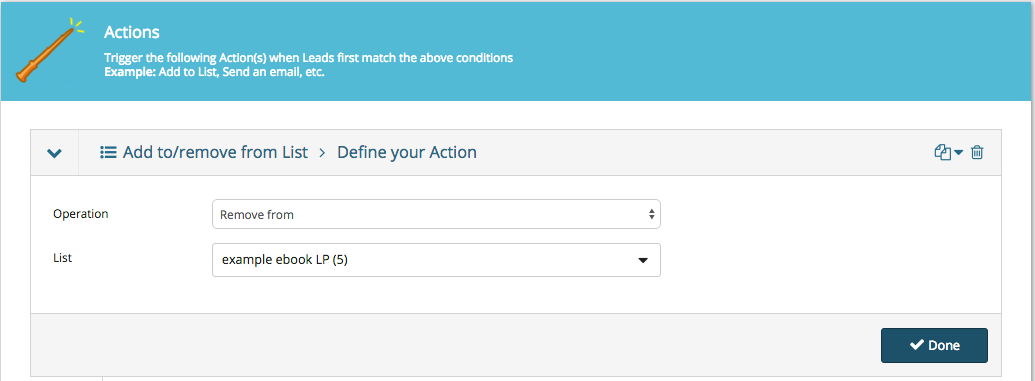
As a result, you need to move them (rather than drop them)...
guide to marketing and sales funnels
This keeps your leads within your brand’s communication strategy and keeps you top of mind.
Important Points about Late-Stage Lead Nurturing:
Often by the time your lead becomes “late-stage” they will already be exploring your business as possibly addressing their pain-points. As such, you don’t want to keep nurturing them if they’re already ready to convert.
The simplest way to ensure your business reacts at the right time (and doesn’t under or over-shoot) is to set up something called lead scoring.
Lead scoring is a feature of marketing automation which assigns values to the actions of your leads.
If a lead goes to your pricing page a couple times in one day you know they’re thinking about a paid conversion. You don’t want to keep communicating with them like they’re a new blog subscriber, but rather push them to act now (perhaps through an exclusive, time-constricted discount or something). 
Lead scoring allows you to do that. Two visits to a pricing page might be the conditions for a lead-score setting of 10, which triggers a late-stage email series or even a sales call.

Marketing and Sales Funnel Stage Five: Retaining Customers


That’s where most sales funnel articles would stop. We’ve generated our lead and nurtured them to a sale.
But this ain’t no ordinary article.
Let’s take it a bit further, because it’s really not too much work to optimize your retention strategy with marketing automation...

Top-of-Mind Campaigns:

It’s substantially cheaper to re-sell to previous customers than to generate new ones (five to ten times cheaper) and they spend around 60% more on average.
So investing in retention is a good policy, particularly because it’s so incredibly easy to set up...
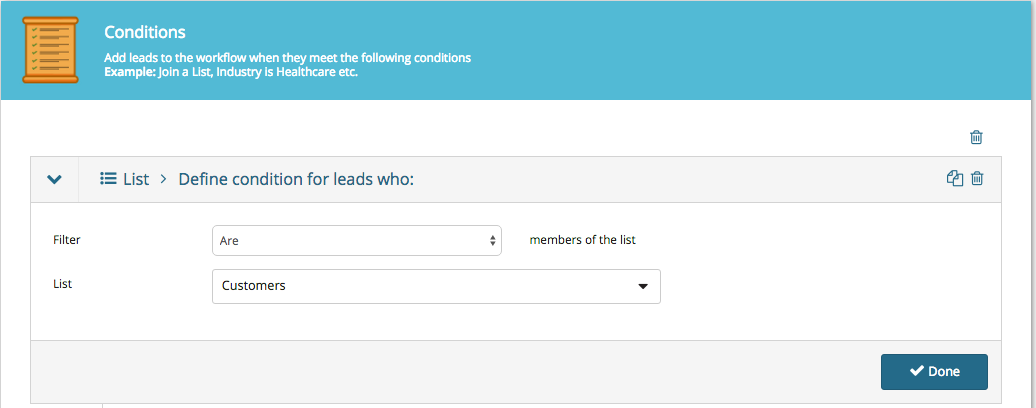
For B2B companies, every time your salespeople or drip campaigns secure a lead’s patronage, their contact details should be added to a “Customers” list (either automatically with a simple workflow, or manually by a sales associate/account manager).
Create a workflow for all people who are added to your “Customers” list:
guide to marketing and sales funnels
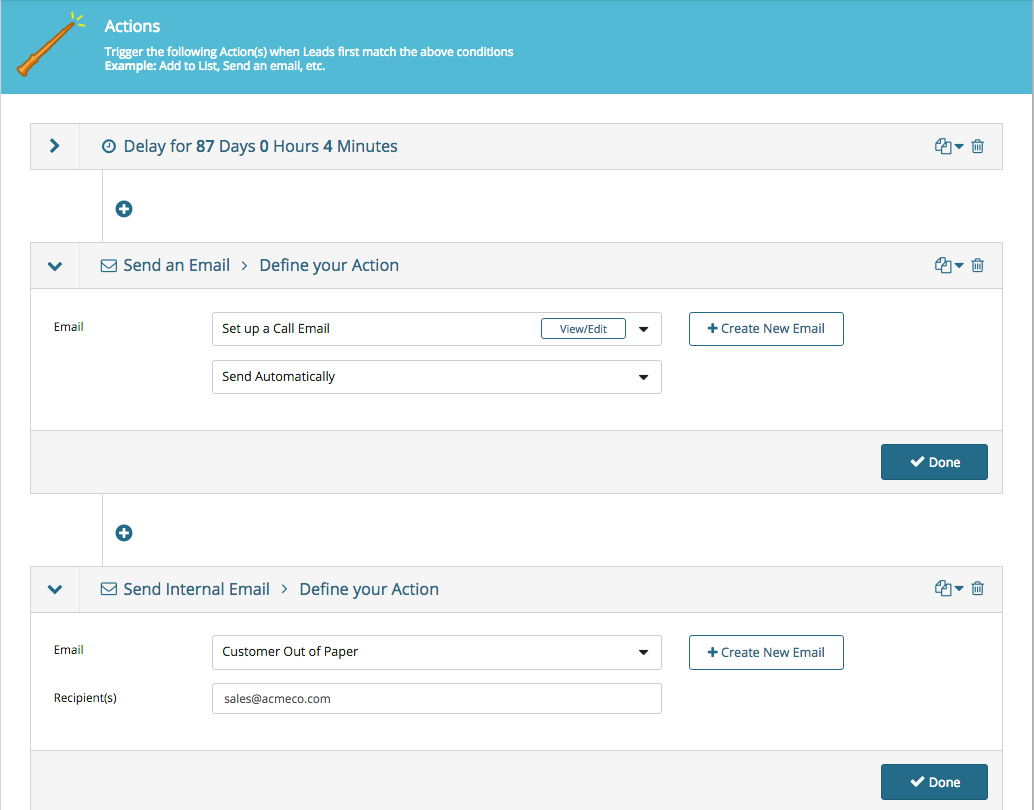
Every time you add someone to your “Customers” list they’ll meet the workflow’s conditions and the actions below will be started:
guide to marketing and sales funnels
The image above is more an example for B2B companies with three-month sales cycle (for instance, you market a company which sells stationery or paper which runs out roughly every 3 months). We set an automatic “are you ready to buy more paper?” email with an 87-day delay.
You’ll also see that we’ve added the action of sending an internal email to the sales team notifying them that one of their accounts needs to be called.
For SaaS or B2C customers, it’s more likely that we’d simply send a marketing newsletter when a sale or platform update is coming up.
That said, you can absolutely automate monthly or bi-monthly “touching-base” emails with marketing automation workflows.
For more on re-engaging leads and customers, check out my article "5 Ways to Engage Email Subscribers that Won't Be Ignored".
Important Points about Top-of-Mind Campaigns:
Marketing automation should make your life easier. It allows you to schedule and optimize communication without thinking about it.
That said, it shouldn’t pinhole you into one single strategy which can’t be changed.
Your marketing automation platform should be flexible and easily-altered. Have a new email or subject-line which has better open or click-through rates? You should be able to plug it in. Have a new lead-generating campaign or ad campaign? You should be able to easily add those new leads to an existing workflow, List, or drip campaign.
10 years ago the problem of marketing automation tools was that they were too rigid.
Yes, if you spent six months (and had a developer) you could create something which did what you wanted it to, but changing it seemed to break the whole process, like a popsicle stick castle - sure it looked pretty, but try to add a new campaign to the bottom and the whole thing topples to the ground.
Fortunately, that’s no longer the case. Check out Wishpond’s marketing automation platform (totally free up to 200 leads) if you don’t believe me.

Conclusion


Hopefully this comprehensive guide has given you a better idea of how a marketing and sales funnel works, as well as how your business might implement one.
If you have any questions about any stage don't hesitate to reach out in the comment section below.